
Building a beach house is one of the most rewarding — and most expensive — types of residential construction. Between elevated foundations, hurricane-resistant materials, salt-air-proof finishes, and strict coastal building codes, beach house construction costs run significantly higher than a comparable inland home. If you’re planning to build on the coast, understanding exactly where your money goes will help you budget accurately and avoid costly surprises.
This guide breaks down beach house construction costs in detail — by square foot, by region, by construction phase, and by the specific coastal factors that drive prices up. Whether you’re building a modest cottage or a luxury oceanfront estate, this article gives you the numbers and the reasoning behind them.
Average Beach House Construction Cost in 2026
On average, building a beach house costs $250 to $550 per square foot, compared to $150–$250 per square foot for a standard inland home. For a typical 2,000-square-foot beach house, that translates to a total construction cost of $500,000 to $1.1 million, not including land.
Here’s a quick breakdown by tier:
| Build Quality | Cost Per Sq Ft | 2,000 Sq Ft Total |
| Basic/Standard | $250–$325 | $500,000–$650,000 |
| Mid-Range | $325–$425 | $650,000–$850,000 |
| High-End/Luxury | $425–$550+ | $850,000–$1.1M+ |
| Ultra-Luxury Oceanfront | $550–$900+ | $1.1M–$1.8M+ |
These figures vary widely by location, lot conditions, elevation requirements, and design complexity, which we’ll cover in detail below
Why Beach Houses Cost More Than Standard Homes
Beach house construction carries a built-in premium of roughly 30–60% more than equivalent inland construction. Several structural and regulatory factors explain this gap.
Elevated Foundations and Pilings
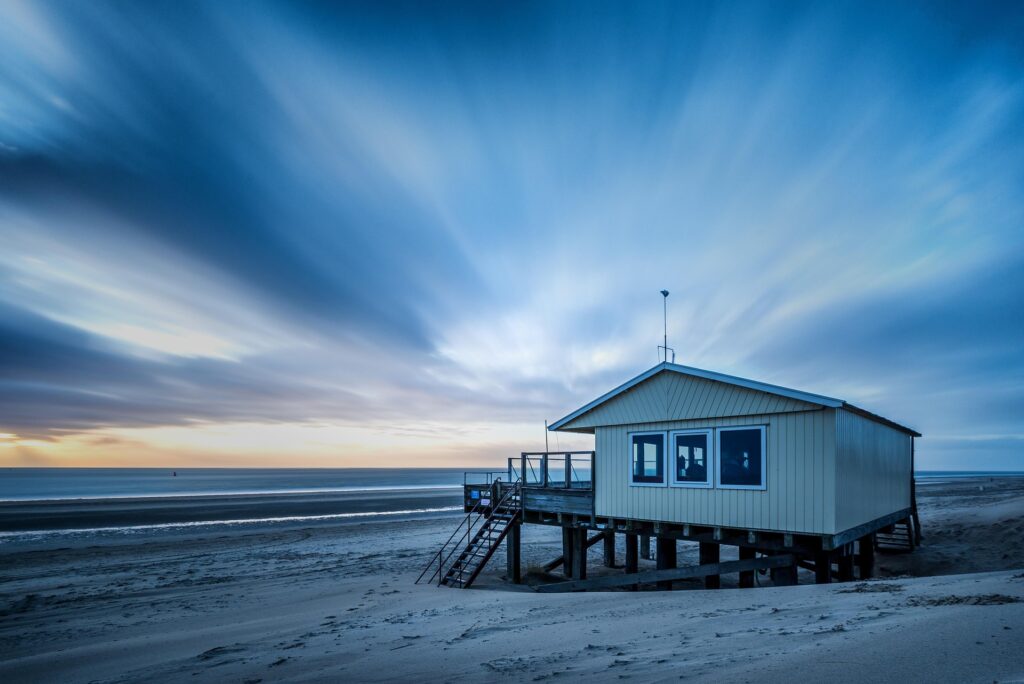
Most coastal building codes require homes to be elevated above the base flood elevation (BFE), often using driven pilings, helical piers, or elevated concrete piers. Pilings alone can cost $15,000 to $60,000+ depending on soil conditions, water table depth, and home size. Homes in high-velocity wave zones (V-zones on FEMA flood maps) require deeper, engineered pile foundations that cost considerably more than standard A-zone foundations.
Hurricane and Wind-Load Engineering
Coastal homes in hurricane-prone regions must meet wind-load standards that can require sustained winds of 130–180+ mph resistance. This means:
- Impact-resistant windows and doors ($800–$2,500 per window vs. $400–$900 standard)
- Reinforced roof trusses and hurricane straps
- Continuous load path framing connecting roof to foundation
- Reinforced concrete or steel structural elements
These upgrades alone can add $20,000 to $80,000 to a mid-sized build.
Corrosion-Resistant Materials
Salt air accelerates corrosion of standard fasteners, metal flashing, and HVAC components. Beach houses require:
- Stainless steel or hot-dip galvanized fasteners
- Marine-grade exterior finishes and coatings
- Corrosion-resistant HVAC and electrical components
- Treated or composite decking instead of standard lumber
Material upgrades for corrosion resistance typically add 8–15% to overall material costs.
Permitting and Environmental Compliance
Coastal construction often involves additional permitting layers: state coastal commissions, wetlands review, dune protection ordinances, and setback requirements. Permit and engineering fees for coastal builds typically run $15,000 to $50,000, compared to $5,000–$15,000 for standard inland permits.
Site Access and Logistics
Many beach lots have limited road access, soft sandy soil that can’t support heavy equipment, or barrier island locations requiring barge-delivered materials. Site prep and material delivery on these lots can add 10–20% to total project costs.
Cost Breakdown by Construction Phase
Understanding where the money actually goes helps you plan a realistic budget. Here’s a typical phase-by-phase breakdown for a 2,000-square-foot mid-range beach house.
Site Work and Foundation (15–20% of budget)
- Site clearing and grading: $5,000–$15,000 Piling/pier foundation: $25,000–$70,000 Flood-compliant elevation work: $10,000–$30,000
Subtotal: $40,000–$115,000
Framing and Structural Shell (20–25% of budget)
- Hurricane-rated framing lumber/steel: $60,000–$110,000
- Roof trusses and hurricane strapping: $10,000–$20,000
- Sheathing and weather barrier: $8,000–$15,000
Subtotal: $78,000–$145,000
Exterior Envelope (15–20% of budget)
- Impact-resistant windows/doors: $25,000–$60,000
- Marine-grade siding/cladding: $20,000–$45,000
- Roofing (metal or impact-rated shingles): $15,000–$35,000
Subtotal: $60,000–$140,000
Mechanical, Electrical, Plumbing (15–18% of budget)
- Corrosion-resistant HVAC: $15,000–$35,000
- Elevated plumbing systems: $12,000–$25,000
- Electrical (including elevated panel placement): $15,000–$30,000
Subtotal: $42,000–$90,000
Interior Finishes (20–25% of budget)
- Flooring, drywall, cabinetry: $50,000–$120,000
- Bathrooms and kitchen fixtures: $30,000–$80,000
Subtotal: $80,000–$200,000
Exterior Living Spaces (5–10% of budget)
- Elevated decks/porches: $15,000–$40,000
- Outdoor staircases: $5,000–$15,000
Subtotal: $20,000–$55,000
Adding these ranges together produces the $500,000–$850,000+ total range cited earlier for mid-range builds, before land, landscaping, and luxury upgrades
Regional Cost Variations
Beach house construction costs vary substantially based on location, largely due to labor rates, local code requirements, and hurricane/seismic risk zones.
Gulf Coast (Florida, Alabama, Mississippi, Texas)
High hurricane exposure drives strict wind-load codes. Costs run $275–$500 per sq ft, with Florida’s Miami-Dade and Broward counties at the high end due to the most stringent impact-resistance requirements in the country.
Atlantic Coast (Carolinas, Georgia, Virginia)
Moderate hurricane risk with strong building codes post-Hurricane cycles. Costs typically run $260–$475 per sq ft.
Northeast Coast (New England, New York, New Jersey)
Lower hurricane frequency but higher labor and material costs, plus nor’easter wind/flood requirements. Costs run $300–$600 per sq ft, with the Hamptons and coastal Massachusetts among the most expensive markets in the country.
Pacific Coast (California, Oregon, Washington)
Seismic engineering requirements combine with high labor costs. Costs run $350–$700+ per sq ft, with California coastal counties often exceeding $600 per sq ft due to land-use restrictions and labor costs.
Gulf of Mexico Barrier Islands
Remote barrier island construction (limited bridge/ferry access) can add a 15–30% logistics premium on top of regional base costs.
Key Cost Drivers You Can Control
While some coastal premiums are unavoidable, several decisions significantly affect your final cost.
Home size and footprint. Cost per square foot typically decreases as total square footage increases, since fixed costs (permits, foundation mobilization, site setup) get spread across more area. A 1,200-square-foot cottage may cost more per square foot than a 3,000-square-foot home.
Foundation type. Helical piers are generally less expensive than driven timber or concrete pilings but aren’t suitable for all soil conditions. A geotechnical survey early in planning can save tens of thousands of dollars by identifying the most cost-effective foundation approach for your specific lot.
Roof design complexity. Simple gable or hip roofs cost less than complex multi-level rooflines, which require more structural reinforcement to meet wind-load codes.
Window-to-wall ratio. Beach houses often emphasize large ocean-view windows, but every impact-rated window is a significant cost line item. Balancing view priorities with window count and size can meaningfully control costs.
Material selection. Composite decking versus real wood, vinyl versus fiber-cement siding, and standard versus premium impact glass each represent cost differentials of 20–50% within the same category
uilder experience with coastal codes. A general contractor without coastal construction experience may underbid the project, leading to change orders mid-build. Choosing a builder with documented coastal/hurricane-zone experience tends to produce more accurate initial estimates and fewer costly surprises.
Hidden and Often-Overlooked Costs
Many first-time coastal homebuilders underestimate several cost categories:
- Flood insurance during construction: $2,000–$8,000 annually depending on flood zone designation
- Builder’s risk insurance: Higher premiums for coastal locations, often 20–40% above inland rates
- Erosion control/dune restoration: $5,000–$25,000 depending on local ordinances
- Utility connections: Extending power, water, and sewer to remote coastal lots can cost $10,000–$40,000+
- Septic systems: Required in many coastal areas without municipal sewer access, costing $15,000–$40,000 for advanced treatment systems suited to sandy soil
- Post-storm contingency: Builders in active hurricane seasons often recommend a 5–10% contingency fund for weather-related delays and material price fluctuations
Beach House Renovation vs. New Construction Costs
If you’re considering buying an existing coastal property instead of building new, renovation costs differ substantially:
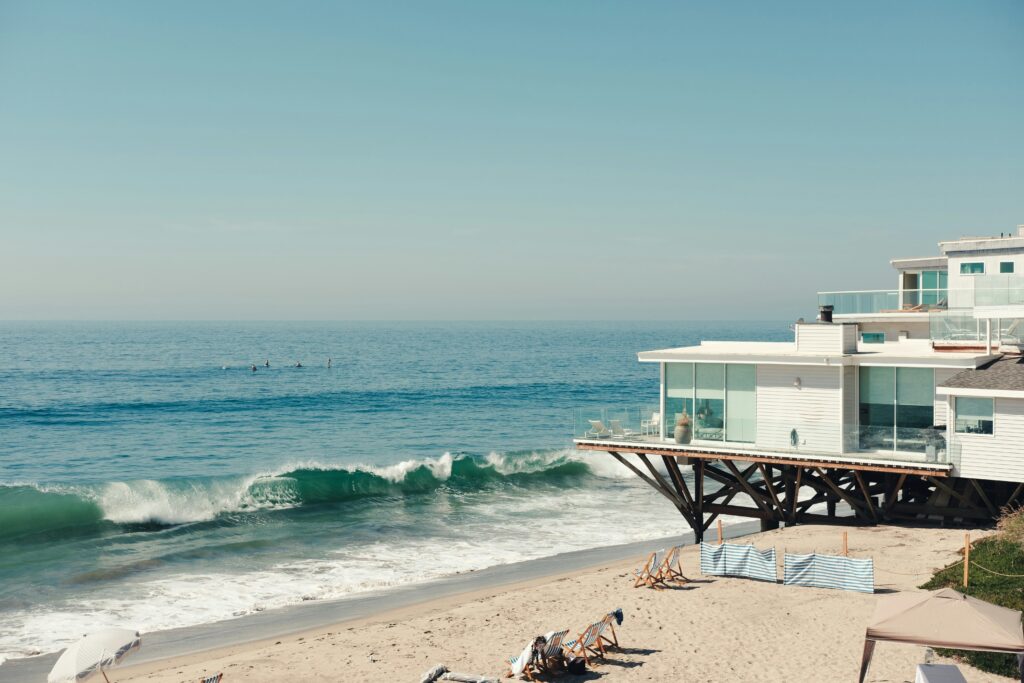
| Project Type | Typical Cost Range |
| Cosmetic renovation (existing elevated home) | $50–$150 per sq ft |
| Structural renovation (foundation/elevation upgrade) | $150–$300 per sq ft |
| Full teardown and rebuild | $250–$550 per sq ft |
| New construction on vacant lot | $250–$700+ per sq ft |
Older beach houses built before modern flood and wind codes often require expensive retrofitting — including raising the structure to meet current base flood elevation requirements, which alone can cost $50,000–$150,000 depending on home size and foundation type.
Financing a Beach House Build
Beach house construction loans typically carry slightly higher interest rates and stricter underwriting than standard construction loans, due to elevated insurance risk and replacement cost. Lenders generally require:
- A detailed cost breakdown from a licensed coastal builder
- Proof of flood insurance commitment
- 20–25% down payment (higher than the 10–20% typical for inland construction loans)
- Builder’s risk insurance covering the full construction period
Construction-to-permanent loans are the most common financing structure, converting to a standard mortgage once a certificate of occupancy is issued.
Frequently Asked Questions
How much does it cost to build a beach house per square foot?
Beach house construction typically costs between $250 and $550 per square foot, depending on location, foundation requirements, and finish quality. Luxury oceanfront builds can exceed $700–$900 per square foot.
Why are beach houses more expensive to build than regular homes?
Beach houses cost 30–60% more than inland homes due to elevated piling foundations, hurricane-rated wind-load engineering, impact-resistant windows, corrosion-resistant materials, and additional coastal permitting requirements.
What is the cheapest way to build a beach house?
The most cost-effective approach is choosing a simple rectangular footprint, a straightforward gable roof, helical pier foundations (where soil conditions allow), standard-size impact windows instead of oversized custom units, and building slightly inland of high-risk V-zones where code requirements are less stringent.
How much does it cost to build pilings for a beach house?
Piling foundations for a beach house typically cost $15,000 to $60,000 or more, depending on pile depth, soil conditions, number of pilings required, and whether timber, concrete, or steel pilings are used.
Do I need flood insurance while building a beach house?
Yes, most lenders and local building departments require flood insurance coverage during construction, typically costing $2,000 to $8,000 annually depending on the property’s flood zone designation.
How long does it take to build a beach house?
A typical beach house takes 10 to 16 months to build, factoring in foundation curing time, hurricane season scheduling considerations, and the additional inspections required for coastal construction.
Final Thoughts
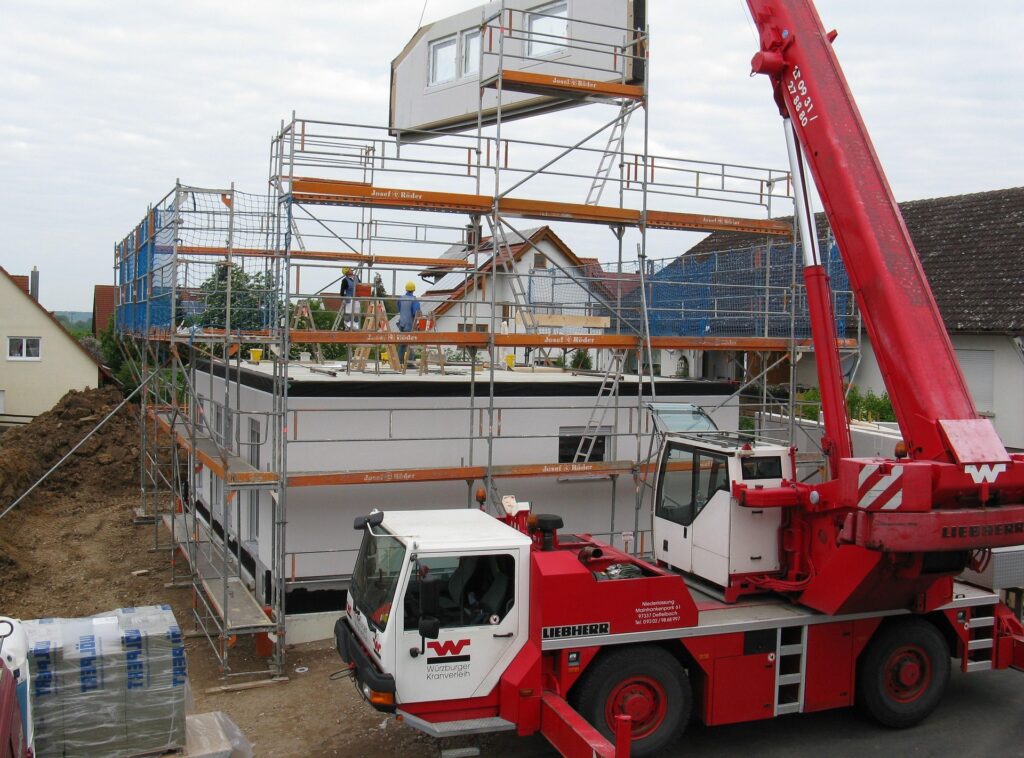
Beach house construction is a long-term investment that demands more upfront planning than typical residential building. The premium you pay — for pilings, impact glass, hurricane bracing, and corrosion-resistant materials — isn’t just a regulatory hurdle; it’s what protects your home and your investment for decades against the exact conditions that make beachfront living desirable in the first place.
Before breaking ground, get a detailed written estimate from a builder with verified coastal construction experience, confirm your lot’s flood zone designation, and budget a realistic contingency for weather-related delays. With accurate planning, most coastal homeowners find that the long-term value and quality of life a well-built beach house provides more than justifies the additional construction investment.